Facts checked Nov 5, 2026 against the sources listed below.
Carnegie Hall is an 1891 building with three halls on different levels, so which seat you buy decides how easy the night is. These are the hall's own accessibility details.
Entrance
The accessible main entrance is the set of double doors closest to Seventh Avenue on 57th Street, into the Box Office lobby. Lobby-to-seat assistance starts one hour before the performance; ask an usher or the House Manager.
Stern Auditorium / Perelman Stage
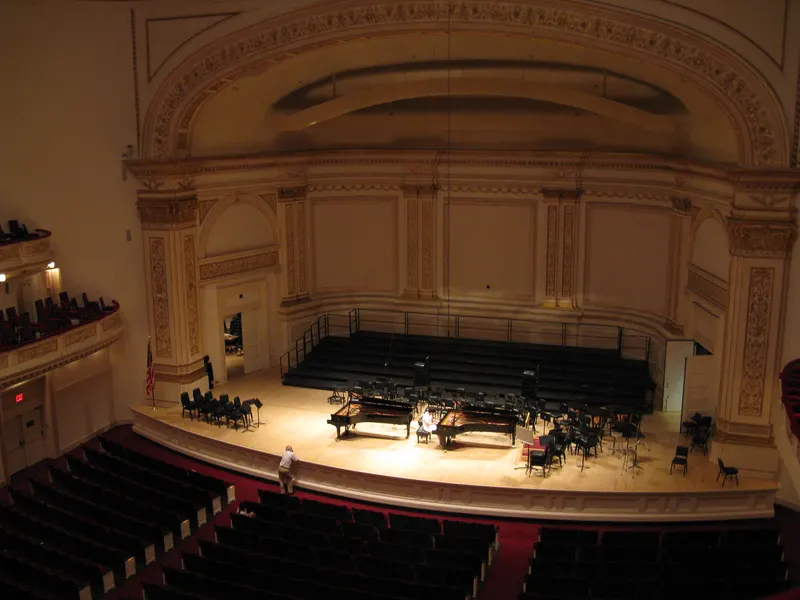
The east and west elevators reach the First Tier, the Second Tier and the Dress Circle; the east elevator also stops at the Parquet. There is no elevator to the Balcony, the top level. The Dress Circle elevator stops running once the concert has begun, so arrive early if you sit there.
Zankel Hall and Weill Recital Hall
Zankel Hall, below street level on Seventh Avenue, has an elevator to all of its levels. Weill Recital Hall, on the third floor, has elevator access to its Orchestra level only; its five-row Balcony has no elevator.
Hearing and sight
Assistive listening devices are offered in all three halls in exchange for an ID. Large-print programs are offered; braille programs need to be requested ten business days ahead (212-903-9605).
Choosing a seat
- Step-free and simplest: Parquet in Stern (east elevator) or any level of Zankel Hall.
- Avoid the Stern Balcony and the Weill Balcony if stairs are a problem.
- Dress Circle: be in your seat before the start, when its elevator stops.
Questions
Is there an elevator to the Balcony at Carnegie Hall?
No. In Stern Auditorium the elevators reach the Parquet, First Tier, Second Tier and Dress Circle, but not the Balcony.
Does Carnegie Hall have hearing devices?
Yes, assistive listening devices in all three halls, in exchange for an ID.
Sources
Checked Nov 5, 2026.